
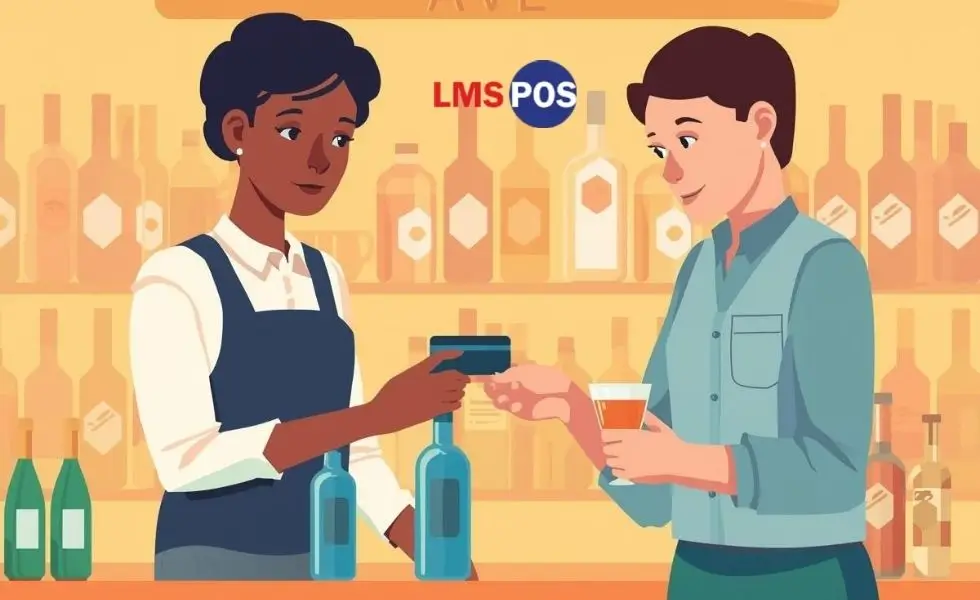
Every liquor store owner in the United States knows the anxiety. A young-looking customer walks up to the counter. Your cashier glances at the ID, makes a quick call, and moves on. But what if they got it wrong?
One failed age verification check can cost you thousands of dollars in fines, your liquor license, or your entire business. That is not a worst-case scenario ,it happens to store owners every year across Massachusetts, New Hampshire, Connecticut, Rhode Island, and beyond.
A liquor store POS age verification system removes that risk entirely. It scans the ID, checks the age, logs the transaction, and either approves or blocks the sale ,automatically, every single time. No guesswork. No human error. No liability exposure.
This guide from LMS POS covers everything you need to know: how the technology works, what the law requires, what to look for in a system, and how to protect your store the right way.
What Is Liquor Store POS Age Verification?
Age verification POS software is a built-in feature that automatically checks a customer’s ID at checkout before completing an alcohol sale. The system scans the barcode on the back of the driver’s license, reads the date of birth, calculates the customer’s age in real time, and either approves or blocks the transaction, all in under two seconds.
It also logs every scan with a timestamp and cashier ID. That means if you are ever audited or inspected, you have a clean, documented record of every age check your store performed.
This is not a luxury feature for large retailers. For any US liquor store serious about staying compliant, it is the baseline.
Why Age Verification Is Critical for Liquor Stores in the USA?
The legal and financial stakes here are not small. One mistake, one sale to a minor, can trigger a chain of consequences that takes years to recover from.
Legal Drinking Age and Compliance Rules
The legal drinking age across all 50 US states is 21. That has been federal law since the National Minimum Drinking Age Act of 1984. No state can lower it without losing federal highway funding.
But each state also layers its own rules on top of that baseline. Many states require staff to check ID for any customer who appears under 30. Some require documented proof of verification. States like Massachusetts, Connecticut, Rhode Island, and New Hampshire run active compliance sting operations targeting retail liquor stores, and they do find violations.
Knowing the federal rule is not enough. You need to know your state’s specific requirements, too.
Risks of Selling Alcohol to Minors
Here is what a single failed verification can cost your store:
- Fines from $500 to $10,000 per violation, depending on state law
- Immediate liquor license suspension pending a compliance hearing
- Permanent license revocation after repeat violations
- Civil lawsuits under Dram Shop Laws if the minor causes harm after leaving
- Criminal charges against the owner or cashier in serious cases
- Reputational damage that drives customers away long after the fine is paid
A single compliance failure can cost more than an entire year of POS software fees. The math on this is not close.
How Does Age Verification Work in a POS System?
The process is straightforward. Here is exactly what happens from the moment a customer puts a bottle on the counter:
Step 1: ID Scanning and Data Extraction
The cashier scans the barcode on the back of the customer’s driver’s license. Most US licenses use a PDF417 barcode format that contains the customer’s full name, date of birth, expiration date, and issuing state. The POS reads all of that in under a second. If the barcode is damaged, OCR technology can read the front of the ID instead.
Step 2: Age Calculation and Approval
The system calculates the customer’s current age based on their date of birth and today’s date. If they are 21 or older, the sale goes through. If they are under 21, the transaction is blocked and the cashier is alerted. No math required. No judgment call. The system handles it.
Step 3: Fraud Detection and Alerts
Good systems do not just read IDs ,they validate them. If the ID format does not match the issuing state’s standards, if the data appears inconsistent, or if the ID has expired, the system flags it before the sale completes. Advanced systems use AI pattern recognition to catch altered or counterfeit IDs that would fool a visual inspection.
Types of Age Verification Methods in Liquor Stores
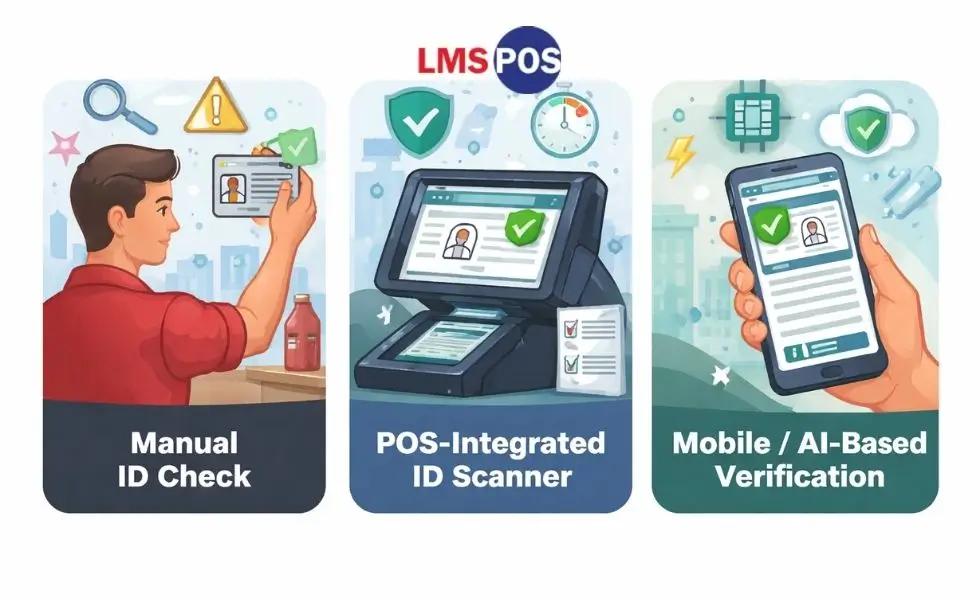
Not every store uses the same approach. Here is how the three main methods compare:
Method | Accuracy | Speed | Compliance Logging | Best For |
Manual ID Check | Variable | Slow under pressure | None by default | Very low-volume stores |
POS-Integrated ID Scanner | Near 99% | Under 2 seconds | Automatic | Most retail liquor stores |
Mobile / AI-Based Verification | High and improving | Fast | Automatic | Mobile POS setups |
- Manual checking depends entirely on your staff’s attention and judgment. That holds up reasonably well during slow hours. It falls apart during a Friday night rush when the line is out the door, and your cashier is tired.
- POS-integrated scanning removes the human variable completely. The scan happens at the register, the log writes itself, and your cashier just confirms what the screen tells them.
- Mobile and AI-based tools are the newest category. Several US states, including Arizona, Colorado, and Louisiana, now accept digital driver’s licenses through apps like Apple Wallet. AI-powered fake ID detection is also improving fast, catching sophisticated fakes that traditional scanners miss.
Key Features to Look for in a Liquor Store POS System
Real-Time Age Verification
The system should prompt for ID automatically when an age-restricted item is scanned, not as an optional step that your cashier can skip. Real-time means the sale cannot proceed until the ID check is completed.
Fake ID Detection Technology
A scanner that only reads barcodes is not enough. Look for systems that validate the data against state-specific ID standards. The best ones catch inconsistencies, like a barcode that encodes a different birthday than what is printed on the front.
Compliance Tracking and Reporting
Every verification scan should generate a timestamped record tied to the transaction and cashier. Monthly compliance reports help you spot gaps, like which shifts have the most skipped prompts or the highest number of declined sales.
Hardware Compatibility
Your software needs to work with reliable 2D barcode scanner hardware. Confirm whether the scanner is included in the package or purchased separately. Some vendors bundle everything together, which simplifies setup significantly.
Cloud-Based Security and Data Privacy
Customer ID data is sensitive. Your POS should store only what is legally required, typically the verification result and timestamp, and should never retain full ID details after the transaction closes.
Why LMS-POS Is Built for Liquor Store Compliance?
Most POS systems on the market were designed for general retail ,coffee shops, clothing stores, hardware outlets ,then adapted to handle alcohol sales as a secondary feature. LMS-POS is different.
Since 2005, LMS-POS has been built specifically for liquor stores, grocery stores, convenience stores, and smoke and vape shops across the United States. Every feature exists because a retail store owner in this industry needed it.
Here is what you get with LMS-POS that generic systems do not offer:
- Integrated ID scanning with real-time age verification triggered automatically at checkout
- Fake ID alerts using barcode validation to flag suspicious or altered documents
- Compliance logging with timestamped records of every age check performed
- Lottery inventory management ,one of the only POS systems that handles this properly
- Dual pricing for cash and card transactions, calculated automatically at the register
- Fully integrated credit card processing with no hidden third-party fees
- Mobile inventory control so you can manage stock from anywhere in your store
- Dedicated technical support from a team that actually understands liquor retail operations
LMS-POS serves independent store owners across Massachusetts, New Hampshire, Connecticut, and Rhode Island, as well as nationwide. Contact us today!
USA Alcohol Laws and POS Compliance Requirements
Alcohol and Tobacco Tax and Trade Bureau (TTB) Guidelines
The TTB is the federal agency that regulates the US alcohol industry. Its primary focus is on producers and importers, but its guidelines set the national compliance framework that shapes state-level retail requirements. Understanding TTB standards gives you context for why your state’s rules exist, and what the federal baseline expects from responsible retailers.
Dram Shop Laws Explained
Dram Shop Laws are state statutes that hold liquor store owners civilly liable when they sell alcohol to a minor or visibly intoxicated person who then causes harm to someone else. These laws are active in most US states, including Massachusetts, Connecticut, Rhode Island, and New Hampshire.
What that means practically: if a cashier sells alcohol to someone who should have been carded ,and that person later causes an accident ,your store can face a civil lawsuit even if you were not at the scene. A documented, automated verification process is your strongest legal defense.
Compliance Checklist for Liquor Stores
- Check ID for every customer who appears to be under 30
- Use an automated POS system that logs every age verification scan
- Train all staff on your state’s specific compliance rules
- Ensure your POS generates reports you can show to inspectors on request
- Post legal drinking age signage at the register and store entrance
- Review compliance logs monthly to catch procedural gaps
- Understand your state’s Dram Shop liability exposure
Manual vs Automated Age Verification: Which Is Better?
Factor | Manual Verification | Automated POS Verification |
Accuracy | Variable | Near 99% for valid IDs |
Speed | 5–15 seconds | Under 2 seconds |
Fake ID Detection | Staff-dependent | AI and barcode validation |
Compliance Logging | Manual or absent | Automatic and timestamped |
Legal Defensibility | Weak | Strong audit trail |
Consistency | Drops under pressure | 100% consistent |
The answer is straightforward. Automated POS verification wins on every factor that matters for compliance and business protection. Manual checking only looks cheaper on day one ,and that advantage disappears the moment you factor in real compliance risk.
Latest Trends in Age Verification Technology in Liquor Store POS
AI-Powered Fraud Detection
The latest systems use machine learning models trained on millions of real and fake IDs. They catch inconsistencies that human eyes and basic scanners miss ,like a barcode encoding a different birthday than what is printed on the front of the ID. As fake ID quality improves, AI detection is the only countermeasure that keeps pace.
Mobile ID and Digital Verification
Several US states now issue digital driver’s licenses through state apps and platforms like Apple Wallet. Arizona, Colorado, and Louisiana are among the early adopters. In states where digital IDs are legally accepted, your POS needs to be ready ,and the best systems are building this capability now.
Biometric Age Verification
Facial age estimation ,using a camera to estimate a customer’s age without requiring an ID ,is being tested in some retail environments. Widespread adoption in liquor stores is still a few years away, but the regulatory frameworks are being developed now. It is worth knowing where the industry is heading.
How to Choose the Right POS System for Your Liquor Store?
- Start with your state’s compliance requirements. Know exactly what Massachusetts, Rhode Island, Connecticut, or your state requires before evaluating any software.
- Confirm native age verification. It should be built into the system ,not handled by a third-party add-on that requires extra steps.
- Ask specifically about fake ID detection. A barcode reader is not the same as a validation system. Ask the vendor how their system handles altered IDs.
- Check the compliance reporting tools. You need reports you can hand to a compliance inspector, with timestamps, cashier IDs, and transaction records.
- Evaluate the total cost of ownership. Hardware, monthly fees, support, and the value of liquor-specific features like lottery management and dual pricing all factor in.
- Choose a vendor with real liquor retail experience. A generic POS company will not understand the difference between a lottery sale and an age-restricted item. LMS-POS was built for exactly this, and has been since 2005.
Final Thoughts
Liquor store POS age verification is not optional. It is a legal requirement, a financial safeguard, and a responsibility to your community. The real question is whether you are handling it in the most accurate, consistent, and defensible way possible.
An automated POS system with integrated ID scanning takes the uncertainty out of every transaction. Your staff stops guessing. Your compliance logs write themselves. Your store is protected by a documented process that holds up under any inspection.
LMS-POS has been helping independent liquor store, grocery store, and convenience store owners across the United States do exactly this since 2005. The system was designed for your industry ,with features that generic platforms do not offer and support from a team that genuinely understands your operation.
Schedule a free demo today and see how LMS-POS makes full compliance straightforward for your store.
FAQs on Liquor Store POS Age Verification
What is age verification in a POS system?
Age verification in a POS system is an automated feature that scans a customer’s ID at checkout and confirms they meet the legal drinking age of 21 before completing the sale. It logs every verification automatically, creating a compliance record for your store.
Is ID scanning legally required for liquor stores in the USA?
ID scanning is not universally mandated by federal law, but most states require strict, documented age verification. Automated POS scanning is the most legally defensible method available and significantly reduces the risk of compliance violations.
Can POS systems detect fake IDs?
Yes. Modern systems use barcode validation, OCR, and AI pattern recognition to flag altered or counterfeit IDs. They cross-check data fields against state-specific ID standards and alert the cashier if anything appears inconsistent.
How much does a liquor store POS system cost?
Hardware typically runs $500 to $2,000 upfront, plus $50 to $200 per month for software. The exact cost depends on features, hardware included, and your store size. Contact LMS-POS for a customized quote based on your specific setup.
What happens if a liquor store sells alcohol to a minor?
Penalties include fines up to $10,000 per violation, liquor license suspension or permanent revocation, civil lawsuits under Dram Shop Laws, and in serious cases, criminal charges. A single violation can cost far more than years of POS subscription fees.
What is the best POS system for small liquor stores?
The best system for a small liquor store combines built-in age verification, ease of use, and features specific to alcohol retail ,like lottery management and dual pricing. LMS-POS is purpose-built for independent store owners and has been since 2005.
How accurate are ID scanners for age verification?
POS ID scanners reading PDF417 barcodes are accurate above 99% for valid, undamaged IDs. They are significantly more reliable than manual visual checks, especially during busy periods when staff attention is divided.
Do POS systems store customer ID data?
Responsible systems store only what compliance requires ,typically the verification result and transaction timestamp. They do not retain full ID information after the transaction closes. LMS-POS follows strict data privacy standards for every customer interaction.
Can I use a mobile POS for age verification?
Yes. Many modern systems offer mobile options with connected or built-in ID scanning. As more US states accept digital mobile driver’s licenses, mobile POS setups are becoming an increasingly practical compliance solution for smaller stores.
How do I choose the right POS system for my liquor store?
Start with your state’s compliance requirements. Then evaluate systems on built-in age verification, fake ID detection, compliance reporting, hardware compatibility, and total cost. Always choose a vendor with direct experience in alcohol retail, not just general retail.